
| By | John Wilkes |
| Scale | 4mm |
| Gauge | 9mm |
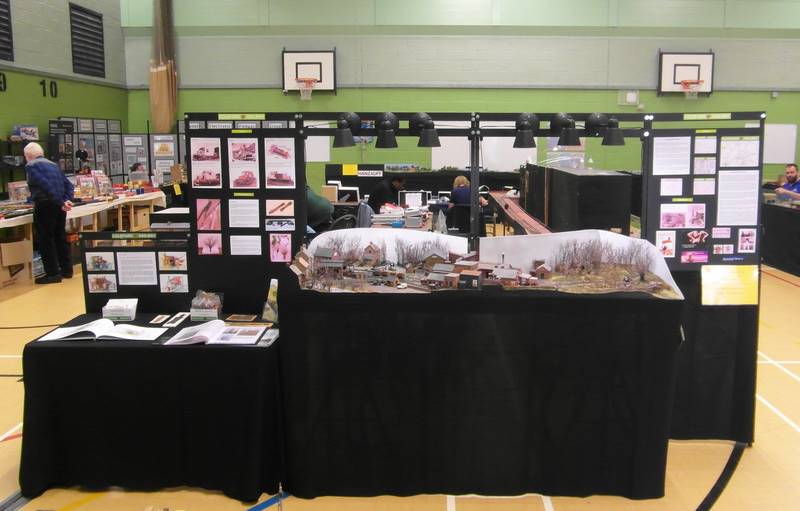
| Size | 12'x 2' |
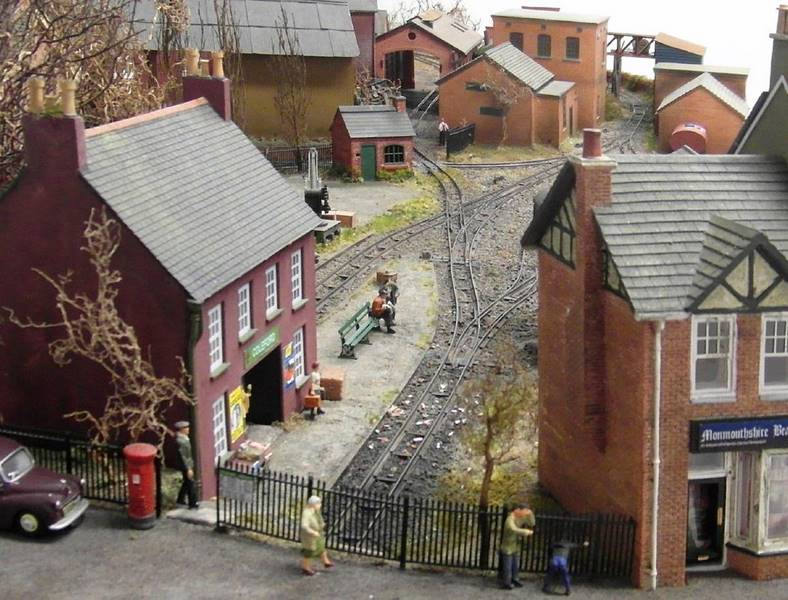
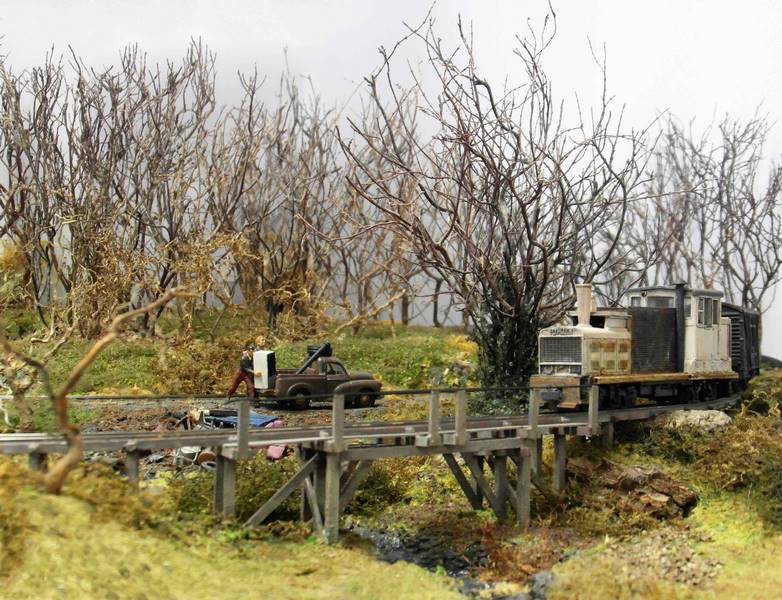
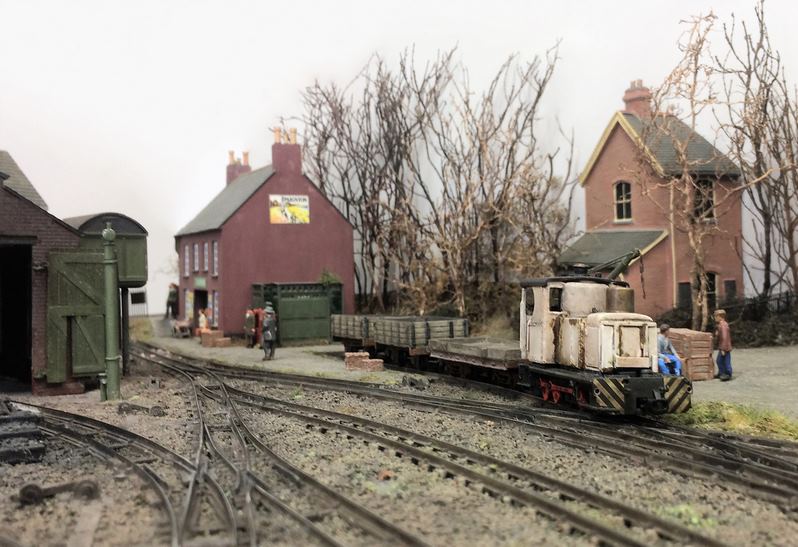
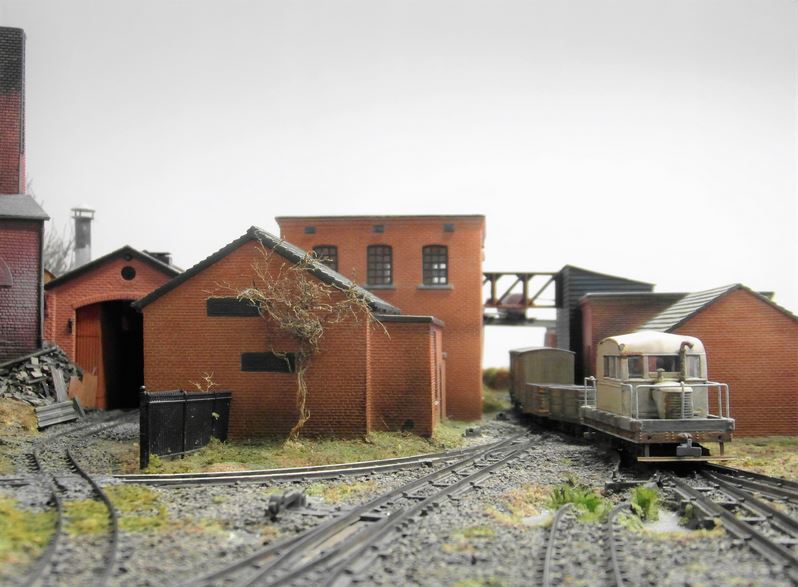
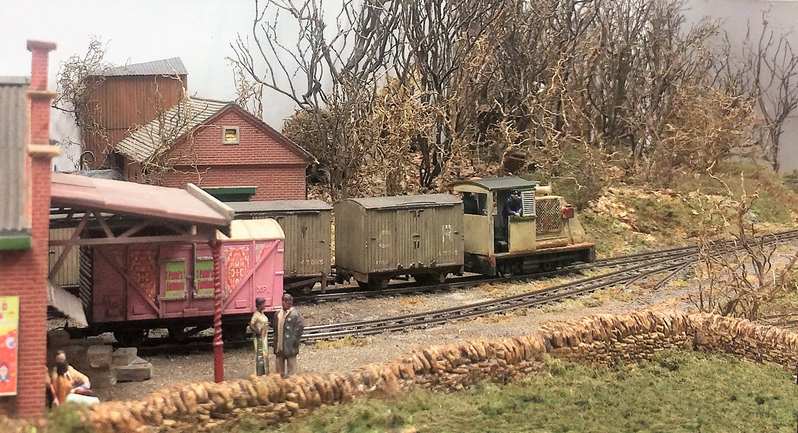
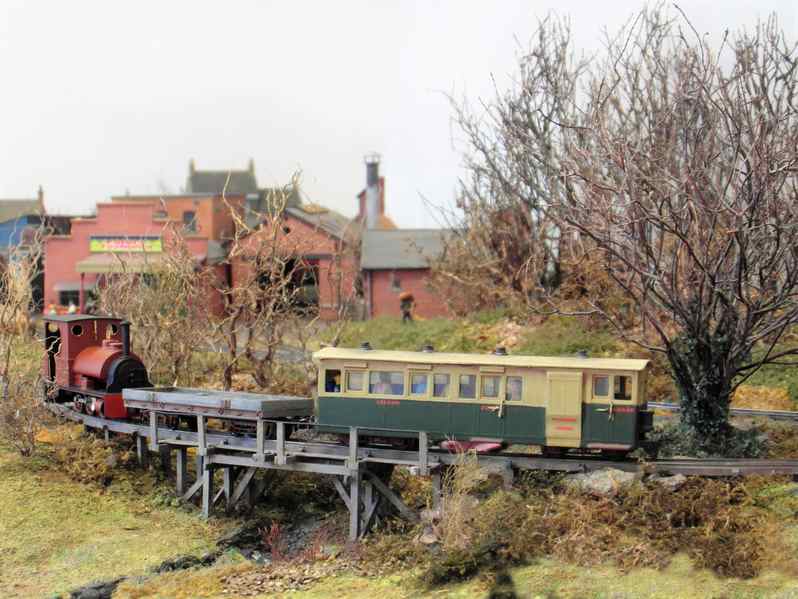
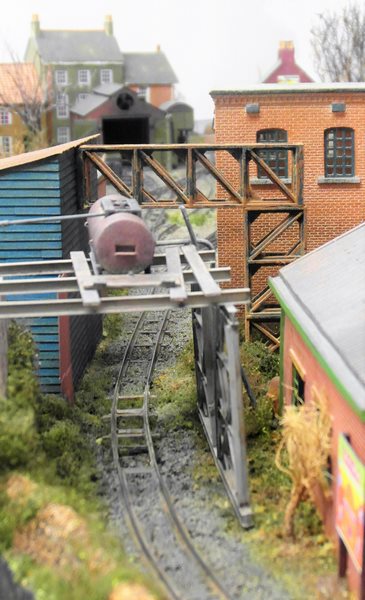
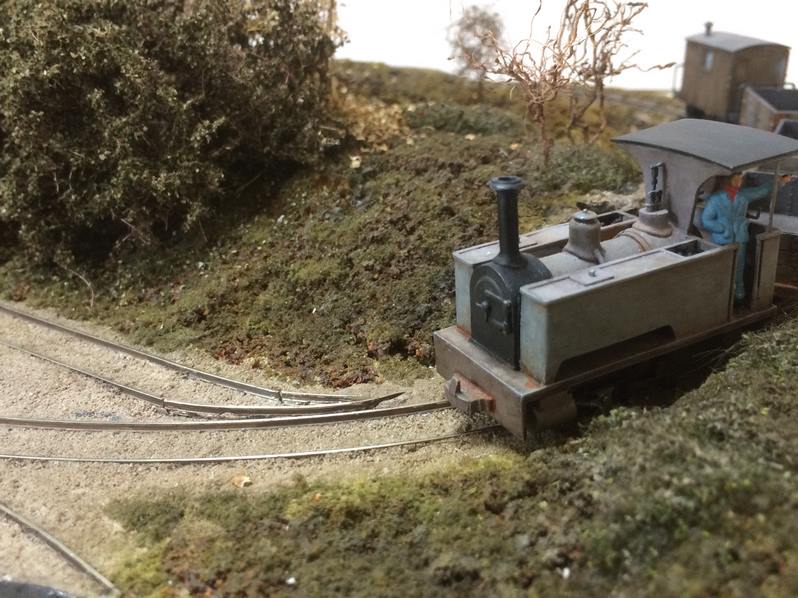
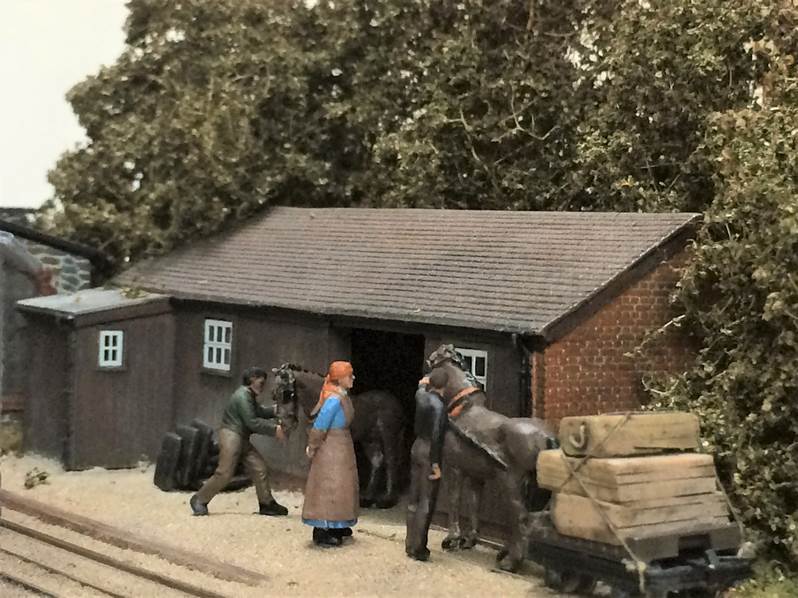
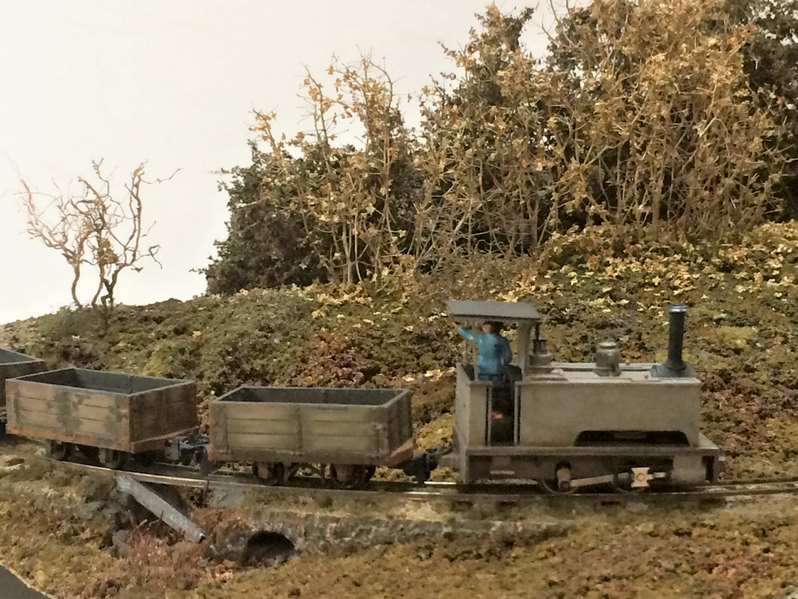
Coleford is based on a real railway in the Forest of Dean, with history having been changed a little ... The railway from Coleford to Monmouth had its origins as a 3’ 6”gauge plateway, the Monmouth Tramway carrying coal, clay and lime to the river Wye at Monmouth. But it’s been reinvented as a 2’ gauge railway serving some quite different industries, gold processing, fashion clothing and a chocolate factory.
I wanted to design something that was portable and not large. At the same time, I wanted something that was interesting to operate. I have always been a fan of unusual trackwork, and on Coleford, there are two different types of track; stone based chairs, and longitudinal sleepers. I used and abused commercially available track to construct these.
The locos and stock are a mixture of bought, kit built and scratchbuilt, including some very unusual locos. Some of the stock is quite unusual too – look out for the chocolate train. The scene shows the railway in a fairly run down state in the depths of winter. So there are lots of bare trees and all the people look miserable!
The layout featured in the May 2013 edition of the Railway Modeller, and has since been extended, nearly doubling its size.
-
 Coleford
-
Coleford
Coleford
-
Coleford
Coleford
-
Coleford
Coleford
-
Coleford
Coleford
-
Coleford
Coleford
-
Coleford
Coleford
-
Coleford
Coleford
-
Life of a Line
Life of a Line
-
Life of a Line
Life of a Line
-
Life of a Line
Life of a Line
https://www.narrowgaugenorth.org.uk/index.php/85-public-news/exhibitors-previous?start=60#sigProIdc543cb3a47
Historical Background
Like other colleagues my interest in model railways has always been there, however once reached the magic age of 60 my body told me that after some 400,000 miles sailing, it was time to become a landlubber. To that end I joined the Falmouth Model Railway Club where there was a cadre of excellent modellers.
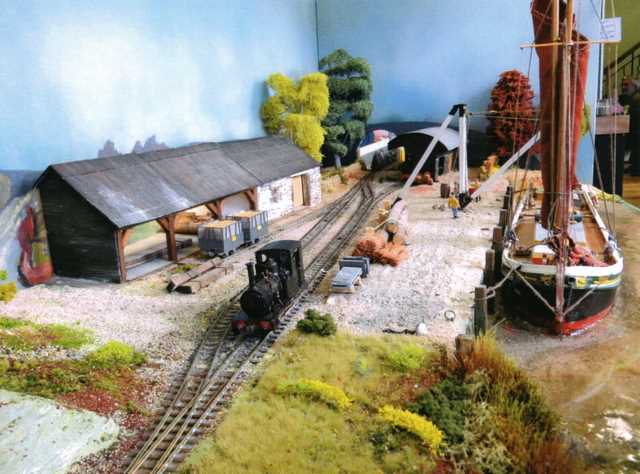
Toms Wharf was constructed as a response to the 5.5mm Association 2011 Challenge that it won. The objective I set myself was to demonstrate modelling of high quality within a small diorama This scene is typical of that to be found in the Thames Estuary or in Essex's coast and rivers.
Methodology
Before starting a project I tend to assess what resources are available. The previous winter I had completed a Billing Model kit of “Will' a Thames Sailing Barge from 1925-1985 (others details indicate it's a 280 ton barque built for F.T.Everard & Sons of Great Yarmouth). This was purchased very reasonably at Beaulieu Boat Jumble. The only problem was that of mounting it on a flat board. As it was built as a full hulled model I was reluctant to either cut a hole in the plywood base or reduce the depth of the hull. The solution was to have the single board split so as to allow the quayside and water element to be made separately as resin and various other heavy materials were to be used. Further it meant that either board once structurally stable could be worked on, on a small table, or in a limited space. So what materials were used and why?
Fortunately a technical career in the Royal Air Force and latterly as a Design Technology teacher has enabled me to use a large variety of materials. I chose now to use the best grade birch plywood, marine plywood, and kiln dried solid soft and hard woods. Aluminium 'L' section is another favourite. Taking a leaf out of lan Rices publications I wanted to try a bow fronted presentation as this had proved interesting on the clubs Helford Gweek Ouay layout. To this end a 6mm birch ply base was cut. The two joining faces, that of the rectangular track board and the quayside board were cut identically (12mm marine ply) and brass bushed joined together using a column drill and clamps. 8mm captive nuts were fitted to quayside board that was then joined (screwed & glued) to its 6mm base. Once dry a West Systems silica fillet was applied. A 12mm square wooden batten was then attached longitudinally thus providing a good base for the plaster preformed quayside walls to be securely fastened with PVA glue. Mooring post slots were filed at appropriate intervals along the Dutch styled stone crafted wall. It was then given a thin coat of mid grey. The mooring posts were stained on three sides, then fitted and together with "Will' all were securely glued in situ. The following day the 30mm edging was cut, pinned, glued and clamped to the edge of the 6mm base.
Water features and vegetation have always interested me and on this model I had a depth of water to play with. As I had the best part of a gallon of casting resin I chose to use this. First painted the creek bottom and added sand and other granule mixes pressing them well down. Naturally with ‘Will' in place the area was greatly reduced and bleedings from the vessel proved interesting. The first layer of resin was then applied and the water vegitation added (reeds etc.). This part of the model was then left to dry for 72hrs. Whilst the resin was tacky some floating items were then placed in position. Finally a major pour of resin was enacted until it overflowed the edging. The slight surplus on the edging acts as a sealing agent for the woodwork.
Turnouts are hand built as is some of the track, the remainder being standard Peco code 75 with the sleepers sanded down. The turnouts are electrically operated by point motors with a switch, and controlled with a standard Gaugemaster PCU2 unit. Track control is by a COMBI. At a later date the turnout micro switches will operate signals where appropriate.
The next structure to be built from scratch using square section brass tubing was the crane. This at present has a manual operation as all the pulley's work, but in the future the intention is to have MERG panel controlled servo motors working the crane functions. A traditional timber yard with its adjoining administrative building was scratch built and the general wharf warehouse facility is a bashed and modified old Wills timber shed model.
Rolling Stock is a mixture of second-hand bits and pieces from the 5.5mm Association and 009 Society. More precisely the loco body was hand built in brass onto a Zeuke Schmalspurbahn TT chassis and due to its weight runs very well indeed. Roy Schofield's ‘Welsh Pony' is featured in some of the images as the author has one these under construction. The mineral and slate wagons together with the carriages are those supplied by Malcolm Savage as are most of the locomotives. The remaining stock is modified and adjusted 14mm NG second-hand equipment.
In 2015 this layout was retrieved from the 5.5 Association and enlarged to 2metres with a fiddle yard and run around loop. The layout is continually being update and electronic modifications are on going!!
Tom Snook January 2016
https://www.narrowgaugenorth.org.uk/index.php/85-public-news/exhibitors-previous?start=60#sigProId57ce2ad328
Mike Lee (Middlesbrough Model Railway Club)
Scale Oe (1-43.5)
Gauge 16.5mm
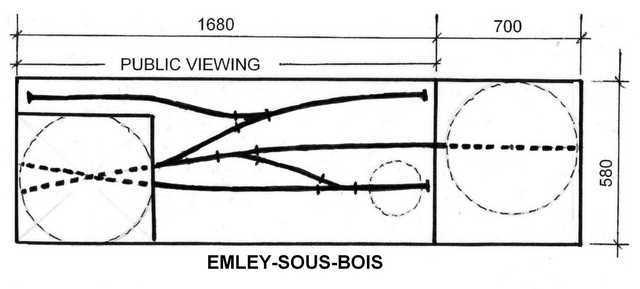
Size 2380 x 580
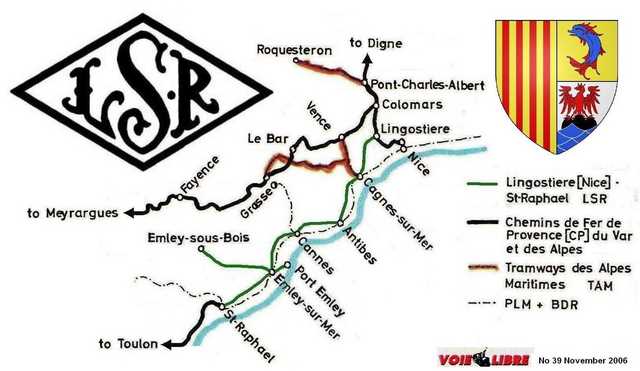
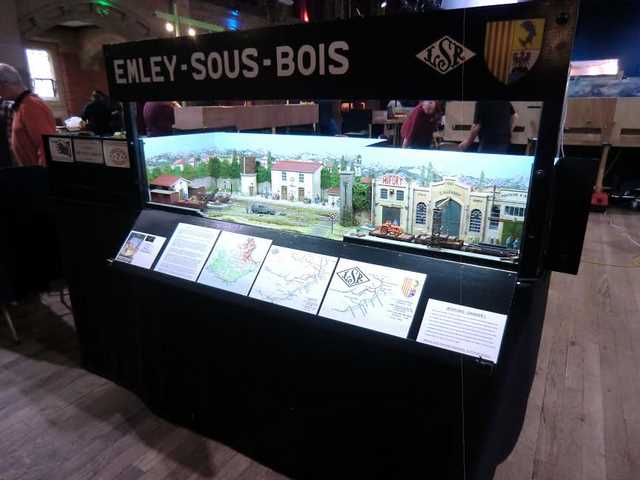
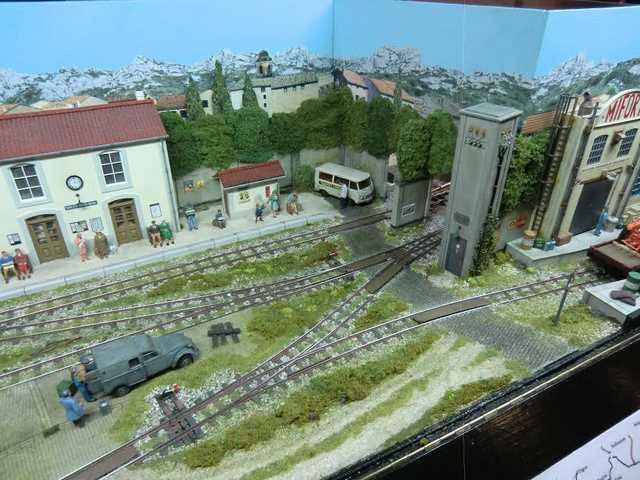
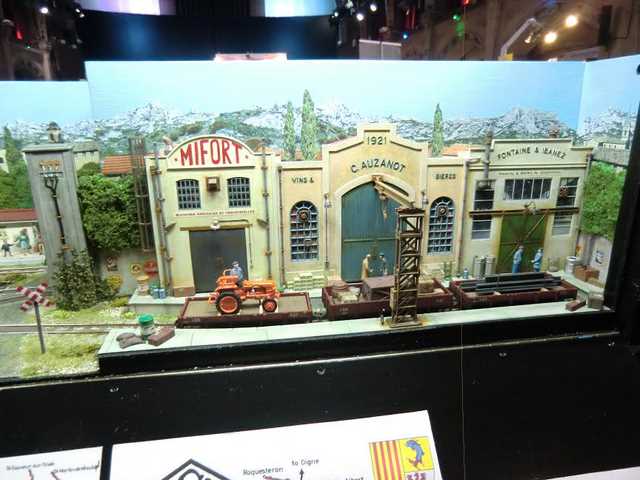
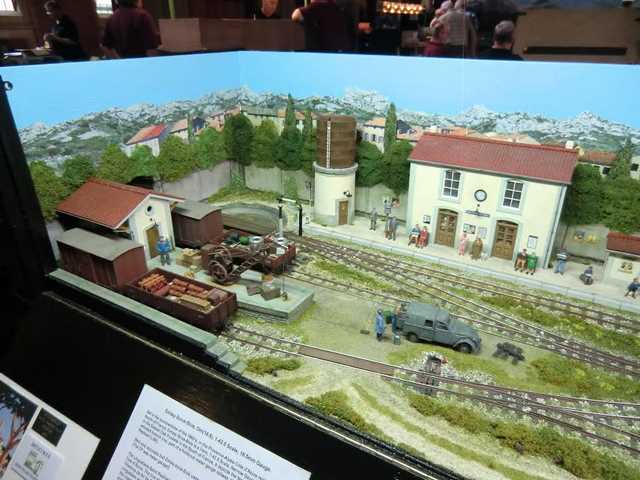
Emley-Sous-Bois is a fictitious town set in the Esterel Forest in the Provence-Alpes-Cote d’Azure region of the South of France in the summertime of the 1960’s. The layout depicts the terminus station of a wooded branch line, part of a fictitious meter gauge railway, the Lingostiere (Nice)-Saint-Raphael, (LSR).
The concept of the layout is that the LSR is a totally independent yet integral part of the Chemins de fer de Provence (CP) network. The CP had three main lines, Nice to Digne, Nice to Meyrargues and an isolated section Saint Raphael to Toulon. When the Lingostiere (Nice)-Saint-Raphael (LSR) proposed their railway the CP welcomed the building of the line. The LSR railway connected the isolated Saint Raphael to Toulon section to Nice making a totally integrated network and offered advantages to both companies.
The LSR had running powers into Nice. Likewise the CP had running powers over the LSR which meant they had a connection all the way from Nice to Toulon.
Passenger traffic is booming due to the number of visitors & tourists to Provence and the French Riviera, as a result of Brigit Bardot’s film ‘And God Created Woman’, not forgetting the excellent climate and French food.
Goods traffic is also booming due to the timber from the forest, Foret Domaniale de l'Esterel, around Emley-sous-Bois, also building stone from the nearby quarries, general goods for the thriving town and raw materials and finished goods from the many local manufacturing industries.
-
Emley sous Bois
Emley sous Bois
-
Emley sous Bois
Emley sous Bois
-
Emley sous Bois
Emley sous Bois
-
Emley sous Bois
Emley sous Bois
-
Emley sous Bois
Emley sous Bois
-
Emley sous Bois
Emley sous Bois
https://www.narrowgaugenorth.org.uk/index.php/85-public-news/exhibitors-previous?start=60#sigProId6c0103f0df
A 009 layout by Paul Titmuss
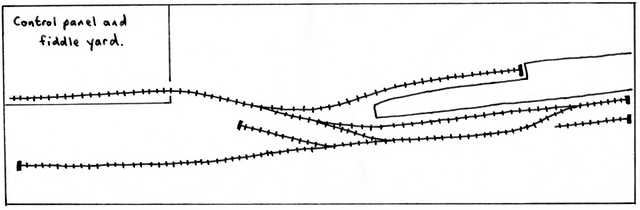
Melton Market started as an ironing board layout for my son when he was aged 16. Then he quickly lost interest in model railways (as most teenagers do) and it languished for some time with no purpose.
Hope materialised as it became the test track for the Oldham 009 group meetings and eventually the track laying was completed.
More time passed and without warning props appeared, such as a platform, and a decision was made to complete the layout. Progress has been slow, very slow. It is a test bed for different modelling techniques such as building constructed using card. Bit by bit changes are taking place and one day, hopefully, it’ll be finished. But don’t hold your breath …
https://www.narrowgaugenorth.org.uk/index.php/85-public-news/exhibitors-previous?start=60#sigProIdc592d6ebf7